Space Exploration / EXPLAINER
Why the Best Route to Another Planet Is Rarely Straight
Space travel begins with a moving destination. The smartest mission plans trade distance against energy, time and the science waiting at the other end.
The destination is already moving
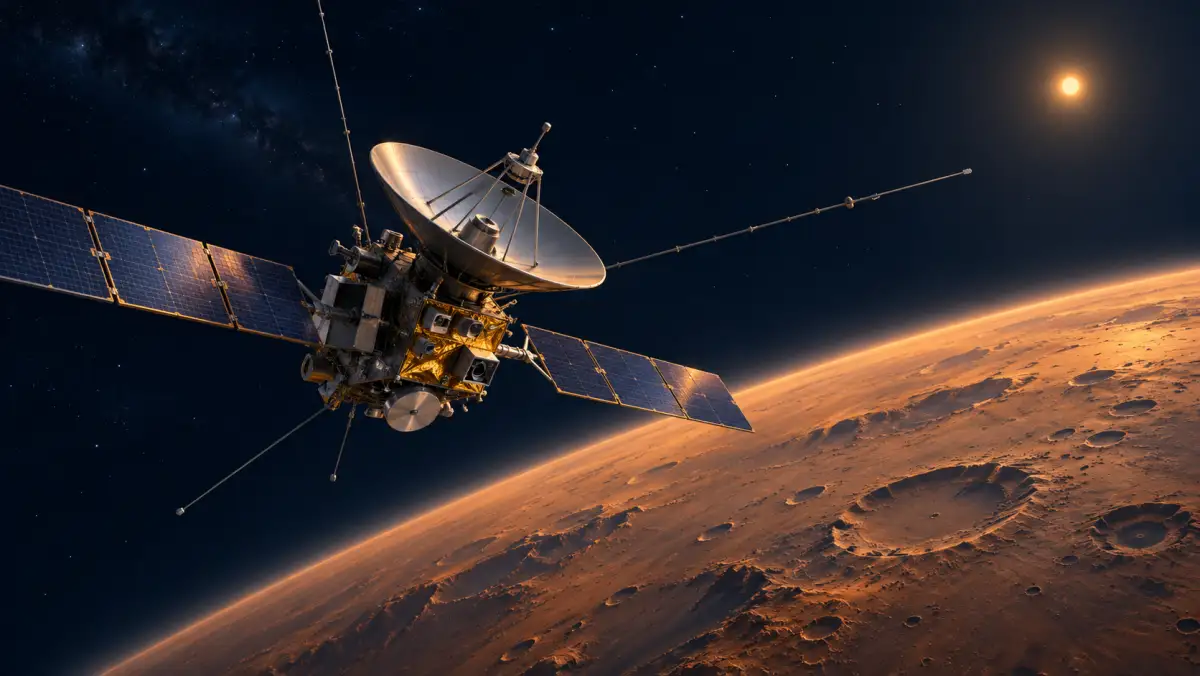
Draw Earth and Mars on a sheet of paper and the obvious route is a line between them. That drawing leaves out the most important part of the journey: both planets are moving around the Sun, and the spacecraft inherits Earth's motion when it departs. A mission must arrive where its destination will be, with a velocity that allows the intended encounter. Reaching the right place at the wrong speed can produce a brief flyby when the scientists needed an orbiter.
NASA's explanation of interplanetary trajectories describes transfers as changes to an orbit around the Sun. This makes departure timing part of the vehicle design. A powerful rocket cannot make every possible departure equally attractive. The arrangement of the planets changes the energy required and the opportunities available along the way.
A longer route can carry more science
A gravity assist uses an encounter with a moving planet to change a spacecraft's path and its velocity relative to the Sun. Depending on the geometry, the encounter can increase or decrease the spacecraft's solar orbital energy. The planet exchanges an imperceptibly small amount of momentum with the vehicle. Nothing about the maneuver creates energy from nowhere.
The practical question is what that encounter buys. A route that saves onboard propellant might allow a heavier instrument, a longer mission or a smaller launch vehicle. The price can be extra travel time and a tighter sequence of encounters. A useful itinerary therefore resembles a carefully timed connection more than an open road: missing one opportunity can change everything that follows.
Distance is only one column in the plan
Consider a fictional mission with two candidate routes. Route A reaches its target in three years and leaves room for two instruments. Route B takes five years but allows four instruments and a larger propellant reserve. These are illustrative choices, not a forecast for any real spacecraft. Neither route is automatically better. If the question requires a particular observation before seasonal conditions change, speed may dominate. If several complementary measurements are essential, the longer route may be worth the wait.
Now add operations. Two additional years mean more scheduling, monitoring and exposure to possible equipment failures. A larger instrument suite also produces more information to store and transmit. Saving launch mass is valuable only when the rest of the mission can support the capability it makes possible.
Arrival happens twice
An event happens at the spacecraft before its signal reaches Earth. NASA distinguishes spacecraft event time from Earth received time because radio signals travel at the speed of light. During a distant encounter, the photograph on a control-room display describes an event that has already occurred. Commands sent in response must then make the return journey.
That delay changes how an encounter is prepared. Engineers need an onboard sequence that can carry out the critical work without waiting for a conversation. NASA's cruise-operations guidance describes schedules that coordinate spacecraft commands, antenna availability and the expected arrival of signals. The choreography includes the ground as well as the vehicle: a successful observation is not finished until useful data have been delivered.
Read a mission map as a set of tradeoffs
When a mission announcement shows an elegant looping line through the solar system, look for three missing captions: what the route enables, what it costs and what must happen on time. A loop may be buying a better arrival condition. A long coast may be a deliberate use of an available orbit. An apparently indirect departure may make a later encounter possible.
For a simple design exercise, choose one scientific question and write down the measurement needed to answer it. Then work backward through instrument mass, power, data return and arrival conditions. Only afterward choose a route. This reverses the familiar temptation to select an exciting destination and assume the science will fit. The best trajectory is the one that delivers the right working observatory to the right place, with enough capability left to make the journey matter.
Sources & further reading
Primary sources behind this article. Illustrative scenarios and design judgments are identified in the text.