Moon & Mars / EXPLAINER
Finding Water Is Not the Same as Building a Supply
Lunar ice and oxygen made on Mars are important discoveries. Turning local material into a dependable supply requires a much longer chain of evidence.
A resource needs an address
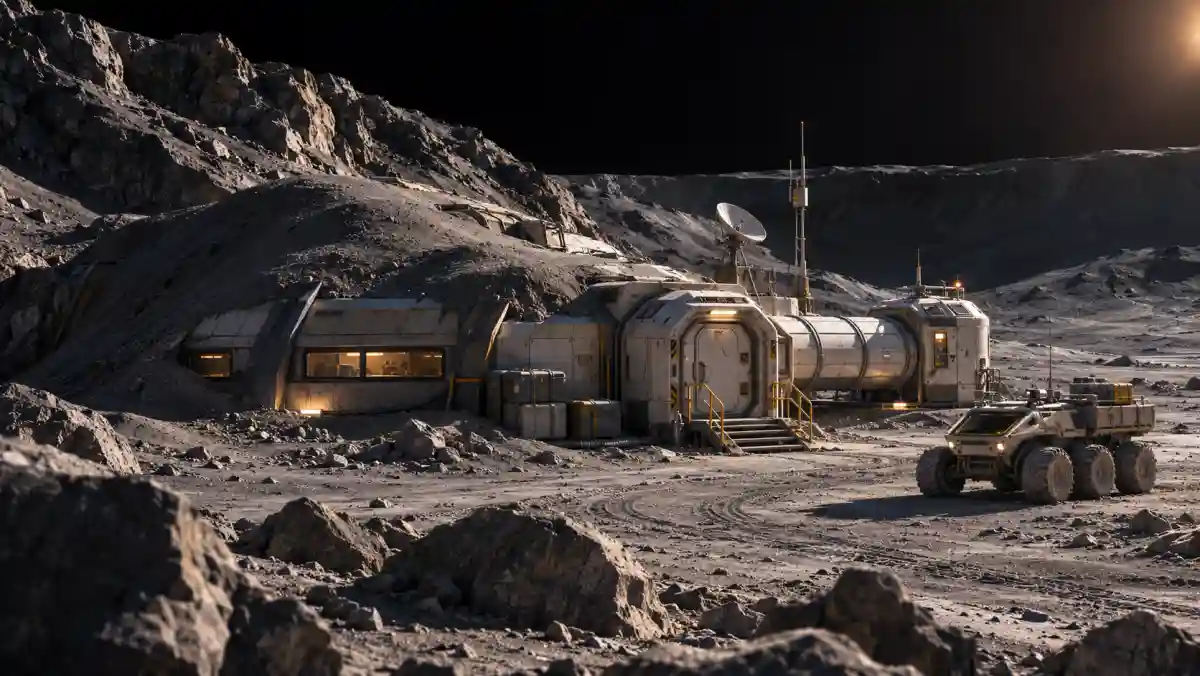
The statement that the Moon has water sounds like a solution. For a mission designer, it opens a list of questions. Where is the water? In what form? At what concentration and depth? How much material must be moved to recover it, and what equipment can survive at that location? A discovery becomes operationally useful only when those questions have sufficiently dependable answers.
NASA's account of lunar water describes several lines of evidence, including observations of material ejected by the LCROSS impact and detections in permanently shadowed regions. These findings establish a scientifically important presence. They do not describe a uniform underground reservoir available wherever a future crew chooses to land. The local conditions still determine the extraction problem.
Cold storage creates a difficult workplace
Some polar regions preserve ice because sunlight does not reach them. The same darkness and cold that help retain volatile materials can complicate the work of finding and collecting them. NASA's lunar south-pole overview emphasizes that the distribution and concentration of frozen materials are complex. A map showing a promising area is the beginning of site assessment, not a finished industrial plan.
Imagine choosing between two fictional deposits. One has a higher concentration but lies far from a useful power source. The other is poorer but easier to reach and survey. Comparing concentration alone misses the transport and energy costs. A mission needs a complete operating area: routes, work locations, power arrangements, communications and a place to put the processed material.
Mars has supplied a valuable demonstration
NASA's MOXIE experiment on Perseverance demonstrated production of oxygen from the carbon dioxide in the Martian atmosphere. Its importance is specific: an instrument performed a resource-conversion process on another planet. It did not establish a complete oxygen supply for a crew or a ready-to-use propellant depot. Producing, collecting, storing and delivering a large quantity are connected but distinct jobs.
The useful comparison with lunar ice is methodological. Both cases require a chain from a naturally available input to a product with a defined use. They involve different environments and processes, so success in one does not automatically qualify equipment for the other. What transfers is the discipline of measuring inputs, outputs and operating conditions, then expanding the demonstration carefully.
Run the material balance before the animation
Suppose a fictional process handles 1,000 kilograms of material containing two percent of a desired substance by mass. The theoretical amount present is 20 kilograms. If the extraction stage captures 60 percent, the output is 12 kilograms before further purification or storage losses. Those deliberately invented numbers are a teaching example, not a claim about lunar deposits or a particular machine.
Now ask what happens if the material contains only one percent. With the same recovery fraction, the output falls to six kilograms. To keep the original production target, the operation would have to process twice as much feedstock or improve another part of the system. This is why representative samples and site variability matter: an optimistic assumption about the input can quietly double the work required downstream.
Build confidence in stages
A sensible evidence ladder starts with detection, moves through local measurement and reaches small-scale extraction. Integrated demonstrations then test how collection, processing, power and storage behave together. Finally, repeated operation establishes what the system can deliver over time. These stages answer different questions. A successful chemistry experiment does not, by itself, reveal how often a dusty connector will need attention.
For readers assessing a Moon or Mars resource proposal, the most revealing request is simple: describe the next test that could change the design. A strong answer names an uncertainty and explains how it will be measured. A weak answer jumps directly from discovery to abundance. Local resources could expand what exploration missions can do, but dependable supply will be earned through a sequence of practical demonstrations, each narrowing the gap between material that exists and material that can actually be used.
Sources & further reading
Primary sources behind this article. Illustrative scenarios and design judgments are identified in the text.