Spacecraft & Propulsion / EXPLAINER
The Patient Power of Electric Propulsion
An engine with a gentle push can transform a mission when it keeps working for months. Understanding that advantage means separating thrust, propellant and power.
The engine that rewards patience
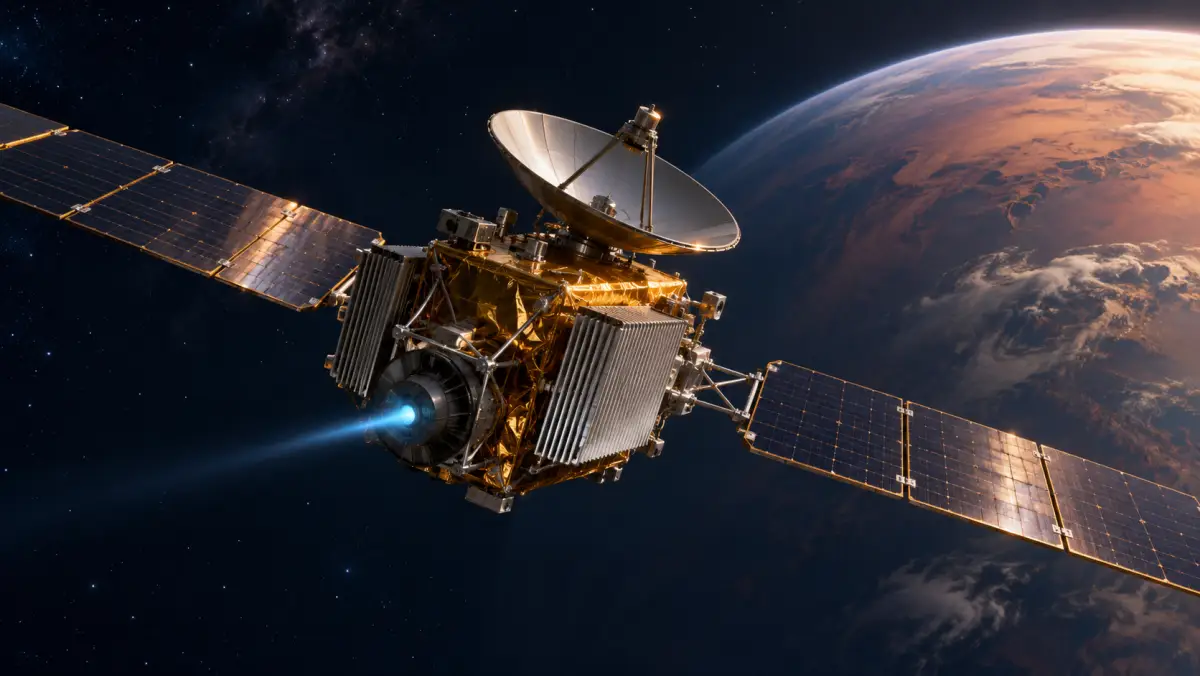
A launch is a demonstration of concentrated force. Electric propulsion tells a quieter story. In space, a small thrust applied for a long period can build a substantial change in velocity. The two scenes serve different jobs: lifting a vehicle away from Earth's surface requires high thrust, while changing an orbit over many weeks can reward endurance and careful energy use.
NASA's Dawn mission demonstrated the significance of that distinction. Its ion propulsion enabled it to orbit both Vesta and Ceres during one mission. This was a working scientific spacecraft, not simply a laboratory argument for a futuristic engine. Its example makes electric propulsion easier to understand: the achievement lay in the trajectory the system could sustain.
Electricity is not the material leaving the engine
Electric thrusters still need something to accelerate. In common solar-electric designs, solar arrays provide electricity and a stored gas supplies the propellant. Electrical processes charge and accelerate that material, which leaves the spacecraft at high speed. NASA's solar-electric propulsion overview describes xenon and krypton among the gases used. The sunlight supplies energy; the gas supplies the expelled mass.
This distinction explains why a large solar array cannot remove every constraint. The engine needs power-processing equipment, propellant storage, thermal control and a structure that holds the system together. A more efficient thruster can reduce propellant demand while making other parts of the spacecraft more demanding. The relevant comparison includes the full installed system.
A tiny acceleration adds up
Take an intentionally simplified spacecraft with a constant acceleration of 0.0001 metres per second squared. Over one day, multiplying acceleration by 86,400 seconds gives a velocity change of 8.64 metres per second. Over 100 days, the same ideal calculation gives 864 metres per second. These are illustrative numbers, not a Dawn performance claim, and they ignore changing mass, thrust direction and periods when the engine is off.
The arithmetic shows why judging this engine by its first second is misleading. It also shows why the schedule matters. If an instrument must observe while the spacecraft points elsewhere, or the available electrical power falls, thrusting may pause. Mission designers must integrate all those periods into the trajectory rather than assume the engine operates continuously whenever convenient.
Choose the engine after choosing the job
NASA's survey of small-spacecraft propulsion describes several electric technologies, including Hall-effect and gridded-ion systems. They do not share identical thrust, power or integration requirements. Chemical propulsion also remains useful, particularly when a maneuver needs substantial force in a short interval. An electric system's propellant efficiency does not make it the right answer to every operational requirement.
Imagine a cargo vehicle allowed to spend many months changing orbit. Its delivery schedule may accommodate low thrust. Now imagine a vehicle facing a brief emergency maneuver with little time to act. The same propulsion characteristics lead to a different choice. A mission can also combine systems, assigning each maneuver to equipment suited to its timing and precision.
Ask for the whole journey
When reading an engine claim, ask how much electrical power it needs, how long it must operate and how much of the spacecraft exists to support it. Then ask what destination and arrival condition the claim assumes. A high exhaust velocity is useful, but it is only one ingredient in a credible transport plan.
For a useful comparison, put two hypothetical spacecraft on the same mission with the same payload and arrival deadline. Count their arrays, tanks, electronics and operating time. Include the periods when the spacecraft must communicate or perform science. This makes the tradeoff visible without declaring a universal winner. Electric propulsion expands the set of missions that can be designed; its strength is most compelling when patience can be converted into reach, useful mass or time spent doing science at the destination. It is the integrated vehicle, flown on a realistic schedule, that turns an efficient engine into a successful mission.
Sources & further reading
Primary sources behind this article. Illustrative scenarios and design judgments are identified in the text.