
Planetary Defense / EXPLAINER
Planetary Defense Begins with a Better Orbit
Deflecting an asteroid is an engineering challenge. Knowing whether and when to act starts with repeated observation.
The first defense is information
The cinematic version of planetary defense begins with an approaching asteroid and a hurried launch. The practical version begins much earlier, with a faint object appearing in images and a growing collection of measurements. Before anyone can consider changing its motion, researchers need to understand which future paths remain consistent with what they have observed.
That distinction makes the ordinary work consequential. A telescope observation can reduce uncertainty about a distant encounter. Another observation can test whether the first interpretation was reliable. The information may eliminate a concern, reveal a need for more attention or help define a potential response. Planetary defense is therefore both an observation system and an engineering capability.
An orbit comes with uncertainty
NASA's Center for Near-Earth Object Studies explains that imperfect observations allow a range of possible orbits. Its Sentry system evaluates potential future encounters for confirmed objects, while Scout provides preliminary assessments for newly detected candidates. A computed path is accompanied by uncertainty because the underlying measurements do not specify a perfectly known state.
For a reader, this means that an impact probability is an assessment based on available evidence at a particular time. It can change as observations accumulate. The number should travel with its date, the object identity and the source that produced it. A screenshot detached from those details can preserve an old estimate long after its meaning has changed.
Why a probability can rise and then disappear
Think of a hypothetical search area drawn around the possible future position of an object. At first the area is broad and includes Earth. New observations shrink it. The portion that overlaps Earth can temporarily become more important before further measurements move the remaining possibilities away. This is an illustration of uncertainty, not a forecast for a particular asteroid.
CNEOS notes that newly listed objects are most often removed from its risk table as additional observations better constrain their motion. A changing assessment is not evidence that the asteroid is behaving unpredictably or that researchers are inventing new rules. It can be the expected result of replacing a wide range of plausible paths with a better-supported range.
DART made one response experimentally real
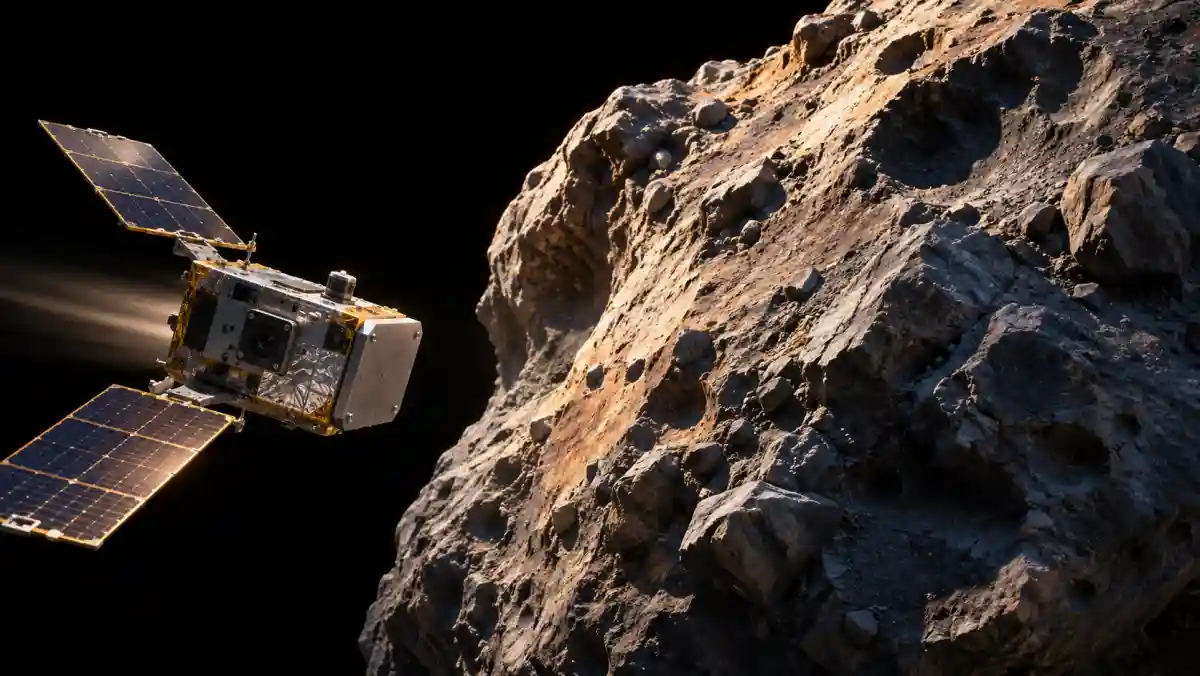
NASA's DART mission struck Dimorphos in September 2022, testing whether a spacecraft impact could alter an asteroid's motion. A later NASA analysis reported that Dimorphos's orbital period around Didymos had shortened by roughly 33 minutes and 15 seconds. The experiment provided physical evidence for kinetic impact as a method of changing an asteroid's trajectory.
The scale and context matter. This was a deliberately selected test in a binary asteroid system, not an emergency intervention against an object approaching Earth. Applying the lesson elsewhere would require understanding the target, its orbit and the available time. One successful demonstration establishes an important capability while leaving substantial engineering work for any different scenario.
Time changes the available choices
A simple arithmetic example shows why warning time matters. If two objects moving in a straight line differ in speed by one millimeter per second, their positions separate by about 31.6 kilometers over a year. Real asteroid deflection involves orbital dynamics, so this is not a mission-planning formula. It is only an illustration of how a small change can accumulate.
An early discovery also allows time to characterize an object, compare response options and check the result of any intervention. A late discovery offers fewer opportunities to gather evidence or prepare equipment. The value of a detection program cannot therefore be judged solely by the drama of its discoveries. It also lies in the choices that timely knowledge makes possible.
A complete system has several quiet parts
The larger picture includes discovery, follow-up, orbit analysis, physical characterization, response development and communication. Each part answers a different question. Where might the object go? How certain is that estimate? What properties affect a response? Which actions are practical in the time available? Weakness in one part can limit the usefulness of progress elsewhere.
Readers can follow this field without treating every newly identified possibility as a countdown. Use the current assessment from the responsible scientific source and distinguish a hypothetical exercise from an actual object. The most persuasive progress combines better knowledge with demonstrated tools. DART gave planetary defense a remarkable experiment; the continuing observations around it give such tools a meaningful problem to solve.
Sources & further reading
Primary sources behind this article. Illustrative scenarios and design judgments are identified in the text.