Advanced Computing / EXPLAINER
The Fastest Computer Can Still Be Waiting for Data
More arithmetic capacity does not guarantee a faster answer. In modern scientific computing, moving information can shape the design as much as processing it.
Watch the gaps between calculations
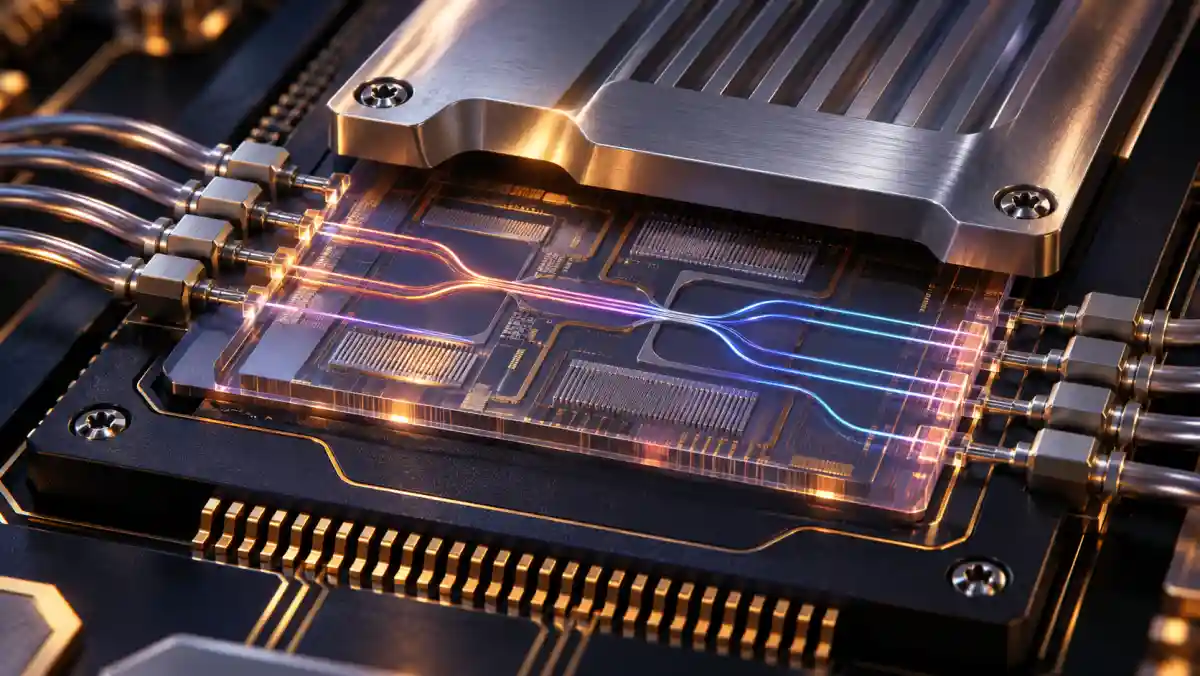
Imagine a kitchen with exceptionally fast cooks and a pantry on another floor. Hiring more cooks helps only until everyone is waiting for ingredients. The same basic constraint appears in computing: processors need data, and transferring that data takes time and energy. A machine can have extraordinary arithmetic capability while an application spends a significant share of its time moving information.
Oak Ridge National Laboratory's Exascale Computing Project report identifies data movement through layered memory systems as a challenge for both performance and power consumption. It also describes the coordination needed between host processors and accelerators. These are central design concerns, not minor housekeeping details to be addressed after the scientific code is finished.
Count bytes alongside operations
A simple performance estimate begins with two quantities: the amount of arithmetic and the amount of data that must move. An operation that reuses information already near the processor can behave very differently from one that repeatedly fetches fresh data. The exact outcome depends on the hardware and access pattern, so measurements remain essential.
Consider a fictional calculation that transfers 800 gigabytes through a path sustaining 100 gigabytes per second. That transfer alone requires at least eight seconds in the simplified model. Making the arithmetic twice as fast cannot reduce the transfer below that bound. If a revised method transfers only 200 gigabytes, the corresponding bound becomes two seconds. These invented values illustrate a design question, not a benchmark for a named supercomputer.
Work where the information already lives
One response is to perform related work while data remain in a useful memory location. Another is to analyze a simulation's output as it is produced, instead of saving every intermediate state for later inspection. An ORNL project report describes this in situ approach as a response to the growing costs of data movement and input/output at exascale.
That choice changes the scientific workflow. Suppose a simulation produces thousands of time steps, but a researcher initially needs only the maximum temperature and the timing of a particular event. Computing those summaries during the run may avoid a large write-and-read cycle. The team still needs to decide which detailed states to retain so that unexpected behavior can be investigated afterward.
Compression of the workflow needs a recovery plan
Discarding unnecessary output can be useful. Discarding the only evidence of an unexpected event is less useful. A practical design therefore distinguishes routine summaries, diagnostic snapshots and restart information. The appropriate mix depends on the scientific question and the cost of repeating the computation. Storage reduction is successful when it preserves the evidence needed to support the result.
ORNL's ADIOS work addresses complex scientific data flows, including exchange among simulations, analysis services and storage. The broader lesson is that data handling belongs in the application architecture. Researchers should know which component owns an output, when it becomes available and what happens if a downstream consumer cannot keep up. Faster calculations can expose an unprepared output stage very quickly.
Optimize the answer, not the isolated component
A useful experiment measures the complete path from input to scientifically meaningful result. Record time spent reading, transferring, computing, communicating and writing. Then change the largest avoidable cost and measure again. An elegant optimization in a rarely used calculation may have less effect than eliminating a repeated transfer in the main workflow.
For the fictional temperature simulation, compare two runs that produce equivalent evidence: one writes every state and one creates validated summaries plus selected snapshots. Check that the event timing and maximum agree within the method's expected numerical behavior. Include the time required to prepare the final analysis. Advanced computing becomes more valuable when this whole process improves. The fastest processor is useful, but the better system is the one that gets trustworthy answers to researchers with fewer unnecessary journeys for the data.
Sources & further reading
Primary sources behind this article. Illustrative scenarios and design judgments are identified in the text.